
Buying Private Party
How Multi Rooftop Dealers Buy Private Party Cars
June 26, 2026
.jpg)
If you're running used car operations across three, five, or ten rooftops, you already know: the auction isn't your friend anymore.
Fees are up. Floors are crowded. Margins on auction units have compressed to the point where turning a profit requires precision you can't always count on.
Meanwhile, private sellers are listing clean, lightly used vehicles every day on Facebook Marketplace, Craigslist, Autotrader, and Cars.com, vehicles that could be on your lot at a fraction of the acquisition cost.
The problem isn't that private-party inventory doesn't exist. The problem is that most franchise dealer groups don't have a repeatable, scalable system for going and getting it.
Here's the operational playbook to fix that: workflows, outreach automation, and KPI reporting for multi-rooftop franchise groups buying private-party cars at scale.
Let's get into it.
Step 1: Centralize Your Private Seller Sourcing
The first layer of any effective multi-rooftop dealership acquisition operation is a unified sourcing feed.
Without centralization, your buyers are tab-surfing. They're manually checking Facebook Marketplace for Rooftop 1, then switching to Craigslist for Rooftop 2, then cross-referencing Autotrader for Rooftop 3.
It's slow, it's redundant, and it guarantees you miss listings.
What centralized sourcing looks like in practice:
A proper listing aggregation setup pulls private-party vehicle acquisition opportunities from Facebook Marketplace, Craigslist, Autotrader, Cars.com, and more then filters them against your exact inventory criteria for each rooftop.
Salvage titles, dealer re-posts, suspicious listings, and vehicles outside your acceptable condition range are automatically removed before your buyers ever see them.
What's left is a curated, up-to-date feed of legitimate private-party opportunities, refreshed in real time, mapped to whichever location makes the most sense based on proximity and inventory need.
For a five-rooftop group, this is the difference between five buyers each spending two hours on manual searching and five buyers spending that same time contacting pre-qualified leads.
Key sourcing capabilities to build or enable:
- Multi-marketplace aggregation (not just one platform)
- AI-powered filtering to eliminate junk listings automatically
- Rooftop-level inventory preference settings (make, model, mileage range, price band)
- VIN extraction and Carfax/history report enrichment: automated, not manual
- Customizable search radius per location
Step 2: Build a Scalable Outbound Outreach System
Here's where most dealer groups leave the most money on the table.
They find the lead. They just don't contact it fast enough or consistently enough.
Private sellers are fielding multiple inquiries. The speed and quality of first contact determine whether your offer is considered. A professional, personalized message sent within minutes of a listing going live performs dramatically better than a generic, “interested in your car?” sent 18 hours later.
Building a scalable outbound car buying operation means automating without sacrificing quality. Here's the operational structure top-performing buy centers use:
Outreach Layer 1: Automated First Contact
When a new listing hits your filtered feed, your platform triggers an automatic first-touch message, SMS, email, or both, personalized with vehicle-specific details (year, make, model, listed price) and sent under your store's identity. This is not a spam blast.
It's a structured, human-sounding message that arrives while the seller's interest is at its peak, often before a competing individual buyer has typed a single word.
A proper automated outreach setup handles this in one place, templated, sent automatically, and fully tracked so your buyer never loses context mid-conversation.
Outreach Layer 2: Follow-Up Sequences
Most sellers don't respond to the first message. That doesn't mean they're not interested; it means they're busy, or waiting to see who else comes in.
A structured follow-up sequence (Day 1 auto-text, Day 3 follow-up email, Day 5 re-engagement message) dramatically increases contact rates without requiring your buyers to manually track who needs a nudge.
The platform manages the cadence. Your buyers manage the conversations that come back.
Outreach Layer 3: Human Escalation at the Right Moment
When a seller responds, the conversation goes directly to a live buyer with full context: vehicle details, outreach history, and seller notes. This is where your dealer sourcing software needs to function like a CRM purpose-built for buying, not selling.
Tagging, notes, appointment scheduling, and deal-stage tracking should all live in one place, not scattered across text threads and sticky notes.
What to standardize across rooftops:
- Outreach templates reviewed and approved at the group level
- Response time SLA, target under 5 minutes for first contact on new leads
- Offer authority and pricing guidelines per vehicle segment
- Appointment and pickup logistics, offering pickup is a genuine competitive differentiator
Step 3: Structure Your Buy Center for Multi-Rooftop Scale
There are two models franchise dealer groups use to run private-party acquisition at scale. Choosing the right one for your group's size and geography matters.
Model A: Centralized Buy Center
One dedicated buy center, typically at your highest-volume store or an off-site location, handles all sourcing and outreach for the entire group. Vehicles are distributed to rooftops based on inventory need.
Best for: Groups with 5+ rooftops in a concentrated geographic area. Enables higher buyer utilization, stronger specialization, and easier group-level oversight.
Requires: A platform that manages multi-location inventory preferences from a single interface with clear routing logic for acquired vehicles.
Model B: Distributed Buyers, Centralized Visibility
Each rooftop has its own buyer, or buyers share across 2–3 stores, but all activity flows into a single dashboard that the Used Car Director reviews centrally.
Best for: Groups with rooftops spread across different markets where local pricing knowledge matters.
Requires: Rooftop-level reporting that rolls up to a group view without anyone manually pulling data.
In both models, the used car inventory acquisition platform is the connective tissue. It ensures that no matter how many buyers you have or where they sit, they're all working from the same playbook, templates, and lead feed.
Step 4: Use AI to Win Deals Before Your Competition Sees Them
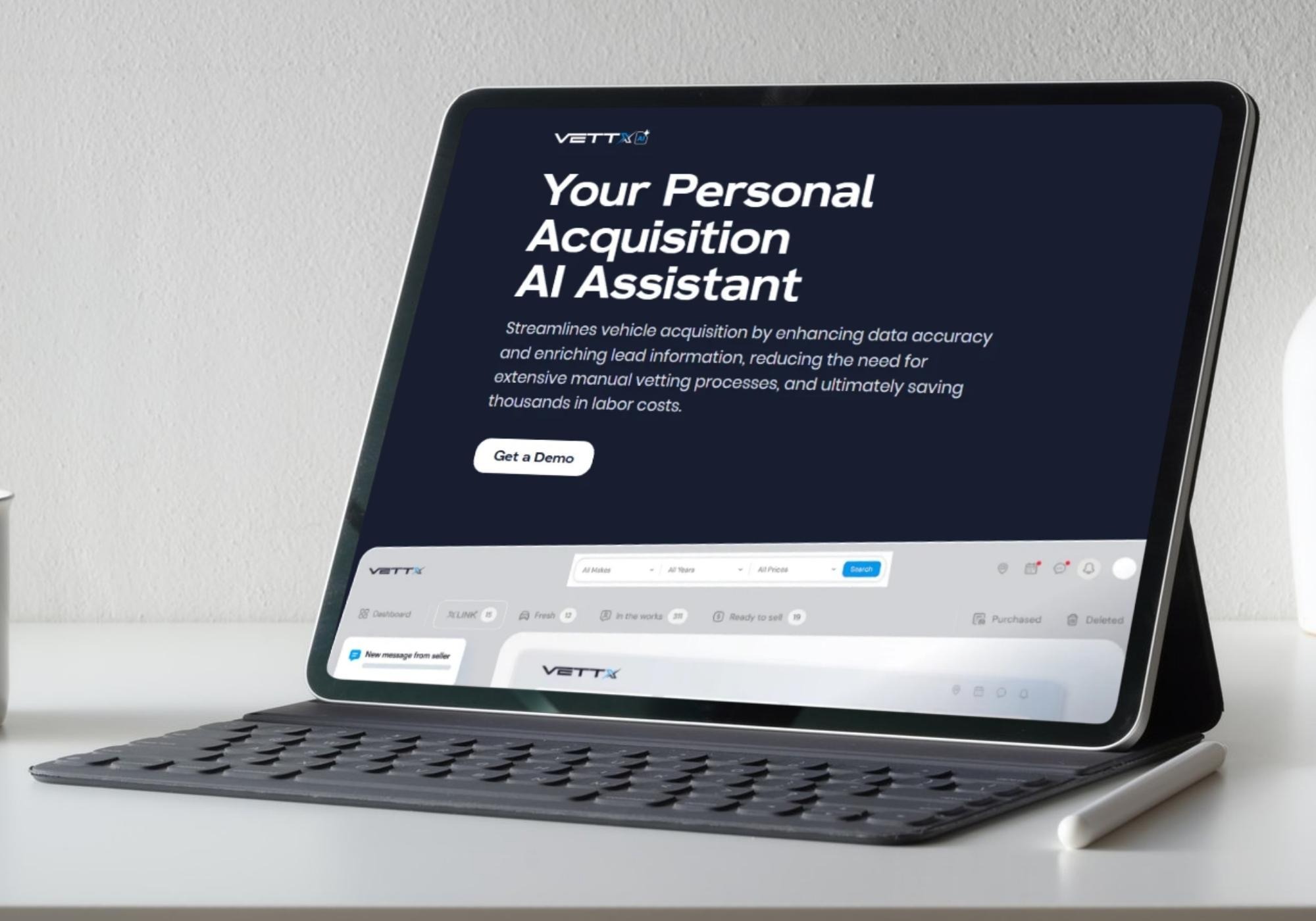
Competing with private buyers for used cars is a speed and information game. Individual buyers are fast, but they're flying blind. No data enrichment, no history reports, no pricing benchmarks. Pure gut.
Your advantage as a dealer is combining the speed of automation with the intelligence of data. With AI-powered acquisition tools, the heavy lifting happens before your buyer ever picks up the phone:
- Scan thousands of listings across all major private-party marketplaces and surface only the ones that match your criteria
- Auto-enrich every qualifying lead with contact information, booking data, vehicle history (Carfax), and market-specific valuation before your buyer ever picks up the phone
- Flag potential issues automatically: salvage titles, rebuilt motors, dealer re-listings masquerading as private sales, suspicious pricing patterns
- Suggest daily deal priorities based on potential gross profit, your current inventory mix, and historical purchase data for your rooftop(s)
- Read license plates from listing images and convert them to VINs instantly, eliminating manual lookup
The operational result: your buyer shows up to every conversation pre-equipped to make a fast, confident offer. The private buyer across town is still trying to figure out if the Carfax is clean.
This is what a modern franchise dealership acquisition strategy looks like, not just buying more cars, but buying better cars, faster, at better margins.
Step 5: Track KPIs Across Every Rooftop
This is where most multi-rooftop operations fall apart, even when everything else is working.
Without structured KPI reporting, your Used Car Director is managing by gut, asking individual buyers how things are going, chasing anecdotal updates, and is unable to identify which stores are underperforming before it becomes a real problem.
A functional multi-rooftop dealership acquisition reporting structure should give you visibility into the following, per store and at the group level:
Contact & Outreach KPIs
Metric Why It Matters
Leads contacted per day (per buyer) Tracks buyer activity and effort
First-response time (avg minutes) Speed is the single biggest driver of contact rate
Contact rate (% of leads reached) Benchmark: 40–60% is strong for private-party
Follow-up sequence completion rate Reveals whether buyers are using the system or bypassing it
Pipeline KPIs
Metric Why It Matters
Offers made per week Leading indicator of deal volume
Offer acceptance rate Reveals pricing competitiveness and buyer skill
Appointments scheduled Middle-funnel health indicator
Appointments held vs. scheduled Reveals appointment quality and seller commitment
Acquisition KPIs
Metric Why It Matters
Units purchased per buyer per month Top performers hit 30+ with the right platform
Cost per acquired unit Critical for margin management across the group
Purchase price vs. book (% to market) Ensures buyers are paying right, not just winning deals
Days to retail ready Connects acquisition to overall inventory velocity
Group-Level Rollup
Metric Why It Matters
Units acquired per rooftop Identifies underperformers and best practices to replicate
Private-party mix as % of total used inventory Tracks progress toward your sourcing channel goal
Gross profit per unit (private party vs. auction) The ultimate ROI argument for the model
When these numbers live inside your acquisition platform, not in a spreadsheet someone updates on Fridays, your Used Car Director can manage the operation in real time, not in retrospect.
Step 6: Build the Playbook and Train Buyers
The platform is the infrastructure. The playbook is the culture.
High-performing buy centers don't just have good software; they have documented processes every buyer follows, regardless of which rooftop they sit in. Here's what that playbook needs to cover:
Outreach standards: What do approved templates look like? What tone do they strike? What's always included in a first message?
Offer authority: What is the buyer's discretionary range? At what price point does an offer escalate to the Used Car Director? What's the walk-away floor?
Appointment logistics: Is the dealer offering pickup? If so, what's the geographic limit? What's the inspection process when a seller arrives?
Objection handling: How does a buyer handle a seller who says, “I got a higher offer”? What's the response when a seller has an emotional attachment to their car and is pushing for above-market pricing?
CRM hygiene: How are notes logged? How are deal stages updated? What triggers a lead to be marked dead vs. paused vs. active?
Our Success Management team works directly with dealer groups to build exactly this, the documented operational framework that top buy centers use to run consistently at volume. For a multi-rooftop group, that support is as valuable as the software itself.
For a comprehensive build-out guide, see: The 2026 Complete Guide to Private Party Vehicle Acquisition.
What the Numbers Look Like When This Works
Private-party vehicles consistently deliver higher gross profit per unit than auction vehicles because you're negotiating directly with a seller who prioritizes convenience over price. With no auction floor to compete against, no buyer fees, and no transportation costs eating into your margin.
- You're negotiating directly with the seller; there's no auction house floor to compete against
- You're equipped with real-time valuation data, so you can price your offer confidently without leaving gross on the table
- You're sourcing vehicles that aren't available to every other dealer bidding in the same lane
To see what this looks like inside a real multi-rooftop franchise group, read the Dutch Miller Auto Group case study.
For a breakdown of what the ROI looks like at the group level, see: The Real ROI of Automated Sourcing for Dealer Groups.
The dealers who build this operation correctly don't just diversify their sourcing channels; they structurally improve used-car profitability across the entire group.
The Bottom Line
The six steps above are how the best multi-rooftop groups are doing it. A unified sourcing feed. Automated outreach that scales. A buy center structure that fits your geography. AI-powered lead intelligence. Real-time KPI visibility. A documented buyer playbook.
That's the outbound car buying operation in practice.
VETTX powers the entire private-party acquisition workflow from listing aggregation and automated outreach to rooftop-level reporting in one platform built for dealer groups buying at scale.
Ready to Build Your Private-Party Acquisition Engine? See how much untapped inventory is available in your market.
Book a demo, and we’ll run a free market analysis showing how many private-party vehicles your buyers could be sourcing right now.
Related Posts
Best Strategies for Buying Cars “Off the Street”
Every dealer in your market is bidding on the same auction cars. Here's how to buy cars from private sellers off the street before your competitors even see the listing.
The Real Cost of Auction Dependence in 2025
Dealer auctions have long been the go-to for acquiring used inventory.
How to Turn Facebook Leads into Real Inventory
Dealers want to buy off the street, but most lack a system. Learn how to turn Facebook leads into a steady stream of real inventory. Stop chasing, start sourcing.
See it in Action
Discover how VETTX can supercharge your vehicle buying center. Schedule a free strategy call with our experts today and take the first step towards dominating your market.
